
It may be hard to understand, but Windows doesn’t drive Nvme SSDs properly. It’s no secret that Microsoft likes to make things complicated. So, from the outset, Windows 11 has not natively supported Nvme SSDs. The OS communicates with NVMe SSDs via a SCSI instruction translation layer, rather than using direct commands. These additional operations, which the OS and hardware components are obliged to perform in order to operate in concert, obviously have consequences not only for performance, but also for memory occupancy.
A “dormant” native NVMe driver under Windows 11.
Nevertheless, in a recent update to Windows Server 2025, Microsoft introduced a long-awaited native NVMe driver. Consumer versions of Windows 11 don’t offer default activation of this driver, yet it’s there, no doubt waiting for yet another update to integrate it. But if you like sports, you can activate it by modifying the registry. Some users have already experimented with this trick successfully, others with a few setbacks.
All you have to do is open the Windows RegEdit registry editor, go to HKEY_LOCAL_MACHINE\SYSTEM\CurrentControlSet\Policies\Microsoft\FeatureManagement\Overrides and add DWORD 32 Bits: “735209102”=dword:00000001 “1853569164”=dword:00000001 “156965516”=dword:00000001
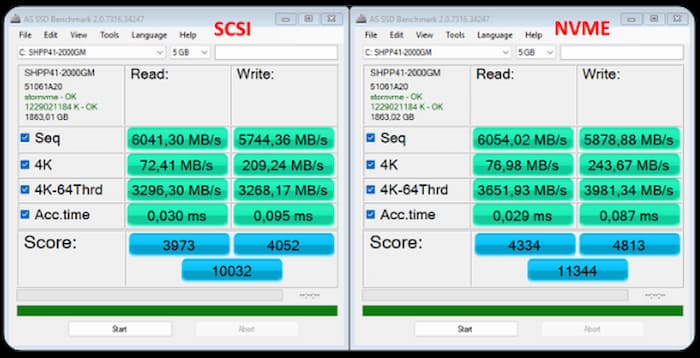
Finally, we’d like to mention the feedback from PurePlayerPC, who activated this recently-released NVMe driver to see its impact on their 2TB SK Hynix Platinum P41 SSD, running on Windows 11 version 25H2. Analysis of the scores obtained via the AS SSD test software shows that this NVMe driver significantly increases random read and write speeds, with write operations particularly benefiting from this hack.
On Reddit, user Cheetah2kkk made similar adjustments to a 4TB Crucial T705 SSD installed in an MSI Claw 8 AI . He saw the biggest gain, with random write rates rising by up to 85%. Naturally, the extent of the gains provided by this NVMe driver will be influenced by the type of drive and hardware involved. We’ll be testing between a rock and a hard place, but it’s possible that PCIe 5.0 NVMe drives will benefit the most from this tweak.
It’s important to note that some users have reported problems with this hack. They were able to backtrack and so the hack had no negative consequences…But if you want to spend the holidays in a certain serene mood, take your precautions.